
HUF Explained: Tax Benefits, Rules and Key Considerations
If you have recently created a Hindu Undivided Family, then this blog is for you. Setting up an HUF is not just a legal formality. It is a long-term financial and tax planning strategy that can significantly improve wealth management and reduce tax liability when structured properly. However, many families create an HUF without fully understanding how it works, what benefits it offers, and the responsibilities it brings.
Read this blog till the end so you know how to use your HUF effectively and avoid mistakes.
Understanding What an HUF Really Is
A Hindu Undivided Family is recognised as a separate legal and tax entity under the Income Tax Act. This means it can own assets, earn income, invest, and pay taxes independently of its members. This structure is available only to Hindu, Jain, Sikh, and Buddhist families.
The head of the HUF is called the Karta. Traditionally, this role was held by the senior-most male member. However, legal developments now allow even a senior female member to become the Karta. The Karta manages financial and legal matters and carries unlimited liability for HUF obligations.
The core members of an HUF are coparceners. These include all lineal descendants of a common ancestor, both male and female. Daughters are coparceners by birth and enjoy equal rights in HUF property. They also have the legal right to demand partition. Other members, such as spouses, are not coparceners but remain entitled to maintenance.
Understanding these roles is important because they affect control, succession, and ownership.
Why HUF Is Considered a Powerful Tax Planning Tool
One of the biggest advantages of an HUF is that it allows income splitting within a family. Since the HUF is taxed separately, the family can distribute income across multiple tax entities instead of concentrating it in one individual.
For example, if the Karta is already in the highest tax bracket of 30%, shifting certain investments to the HUF can help reduce the overall tax burden. If the HUF income falls within the lower slabs, the tax outgo reduces significantly.
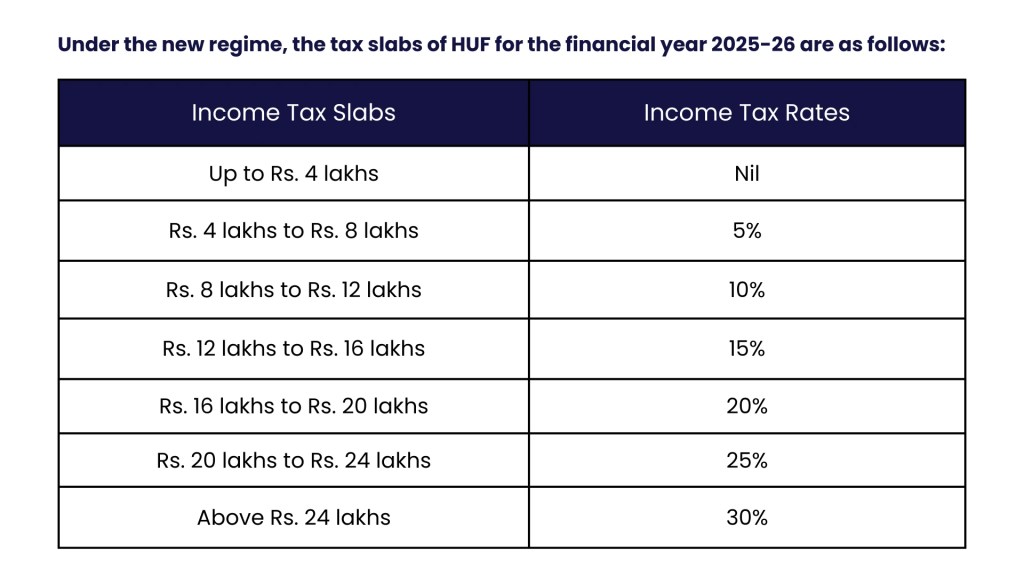
Over time, this can lead to meaningful tax savings.
Independent PAN and Tax Deductions
An HUF has its own PAN and must file its own income tax return. It enjoys the same basic exemption limit and deductions as individuals. This includes deductions under Section 80C up to ₹1.5 lakh for investments such as ELSS, PPF, or life insurance.
The HUF can also claim deductions under Section 80D for health insurance premiums. This creates a separate tax-saving bucket apart from personal deductions.
For families with high incomes, this additional deduction capacity improves overall tax efficiency.
Investment and Wealth Consolidation
Another key benefit is the ability to pool family resources. Instead of managing fragmented investments across individuals, families can build a consolidated portfolio under the HUF. This helps in long-term wealth creation, better diversification, and estate planning.
For example, rental income from ancestral property or income from family investments can be routed through the HUF. This reduces tax leakage and builds a family corpus.
However, not all income can be transferred. Personal income, such as salary or professional earnings, cannot be treated as HUF income. Similarly, income from assets gifted to the HUF by certain members may be subject to clubbing provisions.
Clubbing of Income and Structuring
One of the most misunderstood areas is clubbing. If the Karta transfers personal funds to the HUF without adequate consideration, income generated from such assets may be clubbed with the Karta’s personal income.
This defeats the purpose of tax planning. Proper structuring of gifts, inheritance, and ancestral property is essential to avoid this issue.
Many families overlook this and later face tax scrutiny.
Important Limitations and Risks
While HUF offers advantages, it also comes with limitations. Ownership is collective. The Karta cannot treat HUF property as personal wealth. Any coparcener can demand partition at any time. This can create disputes and fragmentation of wealth.
Compliance is another challenge. The HUF must maintain proper books, file returns, and track income sources. Certain activities, such as earning a salary, are not permitted.
Another practical limitation is that the HUF structure is not suitable for nuclear families with limited ancestral assets. Its usefulness increases with size, assets, and long-term planning.
Dissolution and Partition
An HUF can be dissolved only through partition. This may be total or partial. In total partition, all assets are divided, and the HUF ceases to exist. In a partial partition, some assets are divided, and the rest remain.
The process requires a formal partition deed. Assets are distributed equally among coparceners. The Karta cannot arbitrarily decide the distribution.
Understanding this before creating an HUF is critical because reversing the structure later can be complex.
Continuity and Succession
The HUF does not end with the death of the Karta. The eldest member becomes the new Karta automatically. Assets remain within the family structure and are not inherited individually through a will.
This continuity makes the HUF a powerful long-term wealth preservation tool.
Choosing the Right Compliance Approach
The HUF must file income tax returns using appropriate forms such as ITR-2, ITR-3, or ITR-4, depending on income sources. Proper documentation, structuring, and periodic review are essential.
Without professional guidance, families may not fully utilise the structure or may create tax complications.
Conclusion:
An HUF can be a highly effective strategy for tax optimisation, wealth consolidation, and intergenerational planning. However, it is not just a tax-saving tool. It is a long-term financial structure that requires clarity, discipline, and proper compliance.
Understanding ownership, clubbing rules, and partition rights is essential before transferring assets. The real value of an HUF lies in strategic planning rather than simply creating the entity.
At Moneyvesta Wealth Management Advisory, the focus is on helping families structure their HUF, investments, and tax planning with a long-term perspective. By aligning compliance, wealth creation, and succession planning, Moneyvesta ensures that your family’s financial legacy remains protected and efficient across generations.